
First-Time Home Buyer Programs in Alberta (FHSA, HBP & More)
The FHSA, RRSP Home Buyers' Plan, and two tax credits can free up over $100,000 for your first Alberta home. Here is how each program works and how to stack them against real Edmonton prices.

On this pageShow
Buying your first home in Alberta costs less out of pocket than most people think, because four federal programs stack together to cut your down payment, your taxes, and your closing bill. The FHSA, the RRSP Home Buyers' Plan, the Home Buyers' Amount, and a new GST rebate on new homes can together free up tens of thousands of dollars. Here is how each one works and how to combine them against real Edmonton prices.
✅ Key Takeaways:
- The FHSA lets you contribute $8,000 per year up to a $40,000 lifetime limit, with tax-deductible contributions and tax-free withdrawals for a first home.
- The RRSP Home Buyers' Plan now lets you withdraw up to $60,000 per person ($120,000 per couple), repaid over 15 years.
- You can use the FHSA and the HBP together for the same purchase, stacking up to $100,000 per person.
- Canada's minimum down payment is 5% on homes priced $500,000 or less, so a typical $476,415 Edmonton home needs about $23,821 down.
- First-time buyers also qualify for the $1,400 Home Buyers' Amount tax credit and, on qualifying new builds, a GST rebate worth up to $50,000.
What counts as a first-time buyer
The federal rule is the same for both the FHSA and the Home Buyers' Plan. You are a first-time buyer if you have not lived in a home you (or your spouse or common-law partner) owned at any time in the current calendar year or the previous four calendar years.
So if you sold a home you lived in six years ago and have rented since, you can qualify again. This four-year reset surprises a lot of people who assume "first-time" means literally never owning.
The FHSA: your best first move
The First Home Savings Account is the strongest tool because it works like an RRSP and a TFSA at the same time. Your contributions are tax-deductible, the investment growth inside the account is tax-free, and qualifying withdrawals to buy your first home are also tax-free.
You can contribute $8,000 per year up to a $40,000 lifetime maximum. Unused room carries forward, but only up to $8,000 at a time, so the most you can ever contribute in a single year is $16,000 (one carried-forward $8,000 plus the current $8,000).
To open one you must be a Canadian resident aged 18 to 71 and meet the first-time buyer definition above. The account has a shelf life: you must close it by December 31 of the year you turn 71, or 15 years after you open your first FHSA, whichever comes first. If you do not buy by then, the money rolls tax-free into your RRSP or RRIF, so it is never wasted.
💡 Pro Tip: Open your FHSA even if you can only put in a small amount this year. Opening the account starts the 15-year clock and locks in your contribution room, and you still get the tax deduction on whatever you contribute.
The RRSP Home Buyers' Plan: a $60,000 loan to yourself
The Home Buyers' Plan (HBP) lets you withdraw money you have already saved in your RRSP to put toward a first home. As of Budget 2024 the limit rose to $60,000 per person, which means a couple with separate RRSPs can pull out up to $120,000 combined.
The catch is that this is a loan from yourself. You repay it to your RRSP over 15 years. If you miss a yearly repayment, that amount gets added to your taxable income for the year.
⚠️ Watch Out: There is a temporary grace period. If your home's completion date falls after 2022 and before 2027, the start of your 15-year repayment is pushed back an extra three years, so repayment begins in the fifth year after withdrawal instead of the second. Plan your cash flow around when that clock actually starts.
Stacking FHSA + HBP on a real Edmonton home
Here is the part that changes the math. The Canada Revenue Agency confirms you can make both an FHSA withdrawal and an RRSP HBP withdrawal for the same qualifying home, as long as you meet the conditions for each account.
That means a single buyer can stack a full $40,000 FHSA plus a $60,000 HBP for up to $100,000 toward one purchase. A couple doing the same could reach $200,000.
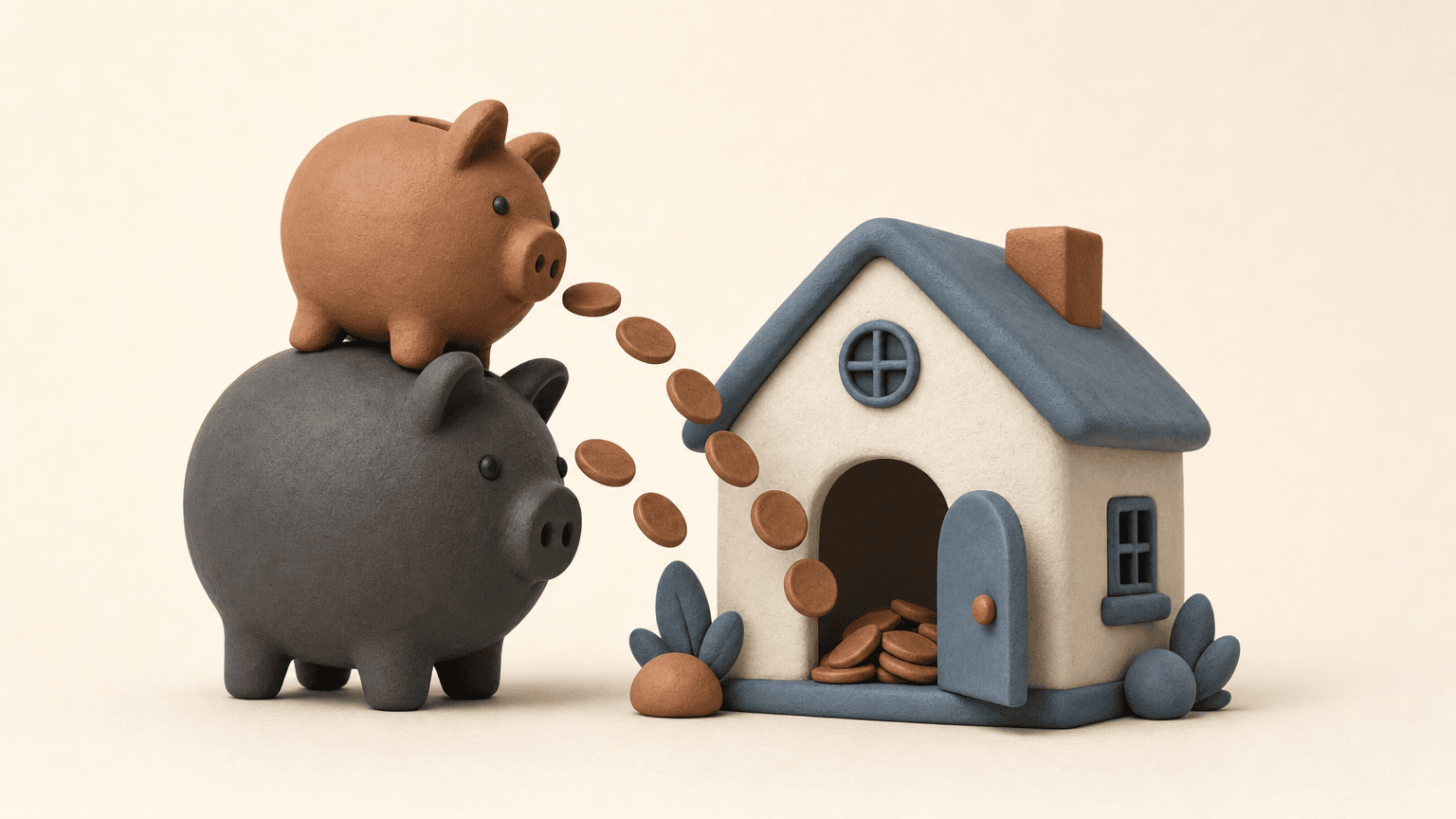 Two stacked tax accounts funding a house down payment
Set that against the Edmonton market. The median sold price for an Edmonton home is $476,415, and these homes are moving at a median of 29 Days on hômm. On a home at that price, the minimum down payment is 5% of the price, which is about $23,821.
📊 Key Stat: The median Edmonton home sold for $476,415, while the median active list price is $543,893. Buyers who anchor their budget to sold prices, not ask prices, plan more accurately.
In other words, a fully funded FHSA alone ($40,000) already covers the minimum 5% down on a typical Edmonton home with thousands to spare for closing costs. Add the HBP and a couple can comfortably clear a 20% down payment ($95,283 on a $476,415 home), which removes CMHC insurance entirely. Want to see what price your savings actually support? Run your numbers through the hômm affordability calculator to find your maximum purchase price after the mortgage stress test, then sanity-check the monthly payment with the mortgage payment calculator.


Down payment rules and CMHC insurance
These are federal rules that apply across Canada. Your minimum down payment depends on price. For homes priced $500,000 or less, it is 5% of the purchase price. For homes between $500,000 and $1,499,999, it is 5% on the first $500,000 plus 10% on the portion above $500,000. At $1,500,000 or more, CMHC insurance is not available, so you need at least 20% down.
If you put down less than 20%, you pay a CMHC mortgage default insurance premium. At 5% down the premium is 4.00% of the mortgage amount. At 10% down it drops to 3.10%, and at 15% down it is 2.80%. At 20% or more, no premium applies. You can estimate yours with the CMHC insurance calculator.
Two federal 2024 reforms help first-time buyers directly. The insured mortgage price cap rose from $1 million to $1.5 million on December 15, 2024, the first change since 2012. On the same date, 30-year amortizations became available to all first-time buyers and all buyers of new builds across Canada, which lowers the monthly payment.
The stress test still applies
Every insured and uninsured mortgage in Canada must pass a stress test. You have to qualify at the greater of your contract rate plus 2%, or 5.25%, whichever is higher. This is why your approved price is usually lower than what the raw payment math suggests.
One recent relief: since November 21, 2024, OSFI no longer requires the stress test for borrowers who do a straight switch to a new lender at renewal. That does not affect your first purchase, but it matters later when your term comes up.
Two more credits worth claiming
Beyond the savings accounts, two tax measures put cash back in your pocket. The Home Buyers' Amount is a federal non-refundable credit of up to $10,000 on line 31270 of your return, worth up to $1,400 in actual tax savings at the current 14% lowest federal rate. You claim it the year you buy.
If you are a first-time buyer purchasing a qualifying new build, the federal First-Time Home Buyers' GST Rebate (announced May 2025) eliminates GST for first-time buyers on new homes valued up to $1,000,000, saving up to $50,000, and partially reduces it on homes between $1,000,000 and $1,500,000. It applies Canada-wide to agreements signed on or after May 27, 2025 and before 2031. Alberta also has no land transfer tax, which already saves buyers here thousands compared with Ontario or B.C.
🎯 The Bottom Line: A first-time buyer in Edmonton can stack a $40,000 FHSA and a $60,000 HBP for up to $100,000 toward a home, claim a $1,400 tax credit, and pay no land transfer tax. With the median home selling around $476,415 and only 5% ($23,821) required down, these programs turn a fully funded FHSA into more than enough for your minimum down payment. Start by checking what you can actually afford, then read the full playbook in how much house you can afford in Edmonton and see how buying works at hômm.
Frequently Asked Questions
Can I use both the FHSA and the RRSP Home Buyers' Plan for the same home?
Yes. The Canada Revenue Agency confirms you can make a qualifying FHSA withdrawal and an RRSP Home Buyers' Plan withdrawal for the same qualifying home purchase, provided you meet all conditions for each account at the time of each withdrawal. A single buyer can stack up to $40,000 from an FHSA and $60,000 from the HBP for $100,000 total.
How much do I need to put down on a typical Edmonton home?
The minimum down payment is 5% on homes priced $500,000 or less. With the median Edmonton home selling for $476,415, that is roughly $23,821. Putting down less than 20% means you also pay a CMHC insurance premium, which starts at 4.00% of the mortgage amount at 5% down.
Do I have to repay FHSA withdrawals like the Home Buyers' Plan?
No. Qualifying FHSA withdrawals for a first home are tax-free and do not have to be repaid. The Home Buyers' Plan is different: it is a withdrawal from your RRSP that you must repay over 15 years, or the missed amount is added to your taxable income that year.
What is the FHSA contribution limit and does unused room carry forward?
You can contribute $8,000 per year up to a $40,000 lifetime maximum. Unused room carries forward, but only up to $8,000 at a time, so the most you can contribute in a single year is $16,000. You must open the account to start accumulating room.
Am I still a first-time buyer if I owned a home years ago?
Possibly. For both the FHSA and the HBP, you qualify if you have not lived in a home you or your spouse or common-law partner owned at any time in the current calendar year or the previous four calendar years. After a four-year gap as a non-owner-occupant, you can qualify again.
Sources
- Financial Consumer Agency of Canada (canada.ca)
- Canada Mortgage and Housing Corporation (cmhc-schl.gc.ca)
- Department of Finance Canada (canada.ca)
- Canada Mortgage and Housing Corporation (cmhc-schl.gc.ca)
- Office of the Superintendent of Financial Institutions (osfi-bsif.gc.ca)
- Office of the Superintendent of Financial Institutions (osfi-bsif.gc.ca)
- Income Tax Act s.146.6 (laws-lois.justice.gc.ca)
- Canada Revenue Agency (canada.ca)
- Canada Revenue Agency (canada.ca)
- Income Tax Act s.146.01 (laws-lois.justice.gc.ca)
- Department of Finance Canada (canada.ca)
- Canada Revenue Agency (canada.ca)
- Income Tax Act s.118.05 (laws-lois.justice.gc.ca)
- Income Tax Act s.117 (laws-lois.justice.gc.ca)
- Canada Revenue Agency (canada.ca)
- Budget 2025 Chapter 3 (budget.canada.ca)

John Rota is a REALTOR® and co-founder of one of Edmonton's top-producing real estate teams, established in 2017. Born and raised in Edmonton, he studied Construction Engineering Technology at NAIT and worked in residential construction before moving into real estate, bringing a builder's eye to construction quality, renovations, and what actually drives a home's value. John writes and reviews Edmonton market and mortgage coverage for homm.ca, grounded in live MLS® data.
What's your home worth?
Get a free home valuation based on recent sales in your area.
Get Your EstimateKeep reading
How Much Down Payment Do You Need in Canada?
The minimum down payment in Canada starts at 5%, but the exact amount depends on the home price. Here are the rules, the CMHC insurance costs, and what 5% looks like on a real Edmonton home.
The GST New Housing Rebate: What First-Time Buyers Should Know
The First-Time Home Buyers' GST rebate returns up to $50,000 on new homes in Canada. Here is who qualifies, how to claim it, and where Edmonton prices land against the thresholds.
Using the RRSP Home Buyers' Plan to Buy Your First Home
The RRSP Home Buyers' Plan lets first-time buyers withdraw up to $60,000 tax-free toward a down payment, or $120,000 for a couple. Here is how it works in Edmonton, plus the repayment rules and how it stacks with the FHSA.
The First-Time Home Buyer's Guide to Edmonton (2026)
Buying your first home in Edmonton means some of the lowest big-city prices in Canada plus the full slate of federal first-time buyer programs. Here are the real numbers and the steps to take.