
Is Edmonton a Good Place to Invest in Real Estate?
Edmonton pairs some of Canada's fastest big-city population growth with the most affordable major-metro prices and rising rents. Here is whether the investment math actually works, using real Edmonton MLS and CMHC numbers.

On this pageShow
Edmonton is one of the strongest real estate investment markets in Canada right now, and the reason is simple math. You can buy a home here for a fraction of what the same place costs in Toronto or Vancouver, the population is among the fastest growing of any major Canadian city, and rents are climbing while homes stay genuinely affordable. This article walks through the real numbers so you can decide if the case holds up for your own budget.
✅ Key Takeaways:
- Edmonton's average resale price was $424,510 in 2024, roughly a third of Toronto's or Vancouver's, according to CMHC.
- The Edmonton census metropolitan area grew 3.0% in the year ending July 2025, among the fastest of any major Canadian metro (Statistics Canada).
- The median Edmonton residential home sold for $472,584; the median condo sold for $250,647, about 53% of the all-residential median price.
- Average 2-bedroom purpose-built rent reached $1,603 in October 2025, up 3.5% year-over-year, with a 3.8% vacancy rate (CMHC).
- Run your own numbers with the free cap rate calculator before you commit to any property.
The short answer: yes, the fundamentals are strong
A good investment market needs three things working together. People moving in, rents that cover your costs, and prices low enough that the math actually works. Edmonton has all three at the same time, which is rarer than it sounds.
Most Canadian cities have the demand but not the affordability. Toronto and Vancouver draw plenty of people, but at over $1.1 million average resale prices, the rent almost never covers the mortgage. Edmonton flips that problem. Strong demand meets prices that still leave room for positive cash flow.
That does not make every Edmonton property a winner. It means the city gives you a fighting chance to find one, which is the whole game in real estate investing.
Population growth is driving the demand
The clearest signal for any investor is whether people are arriving or leaving. In Edmonton, they are arriving fast.
The Edmonton census metropolitan area grew 4.1% in the year ending July 2023, then 4.5% in the year ending July 2024, then 3.0% in the year ending July 2025. That 3.0% was among the largest growth rates of any Canadian metro area for that period, according to Statistics Canada.
A big part of that came from people moving here from other provinces. Edmonton recorded a net interprovincial migration gain of 16,082 in 2022 to 2023 and 13,893 in 2023 to 2024, described by Statistics Canada as among the highest in over 20 years. People leave expensive cities, keep their jobs or find new ones, and stretch their money further here.
📊 Key Stat: Edmonton grew 3.0% in the 12 months ending July 2025, among the fastest growth rates of any Canadian census metropolitan area (Statistics Canada).
Builders noticed. Edmonton recorded 13,359 housing starts in the first nine months of 2024, a 47% jump over the same period in 2023. New supply is the one thing that can cool a hot rental market, so this is worth watching, but starts at this level reflect real builder confidence in continued demand.
Affordability is the edge over other big cities
Here is where Edmonton separates itself. The same dollar buys far more home.
CMHC reported Edmonton's 2024 average resale price at $424,510. Compare that to $622,457 in Calgary and $1,234,969 in Vancouver. Edmonton's price was roughly a third of Vancouver's for the same year, and Toronto sits in the same seven-figure range as Vancouver.
CMHC's affordability index tells the same story. For the fourth quarter of 2025, Edmonton ranked as the most affordable major Canadian city with a homeownership score of +1.572, far ahead of Calgary at -0.260, while Toronto sat at -5.570 and Vancouver at -5.961.
Looking ahead, CMHC's 2026 outlook forecasts Edmonton's average resale price in the $420,000 to $480,000 range. Calgary is forecast at $610,000 to $680,000, while Vancouver is forecast in a wide $1.11 million to $1.35 million band. The gap is not closing.
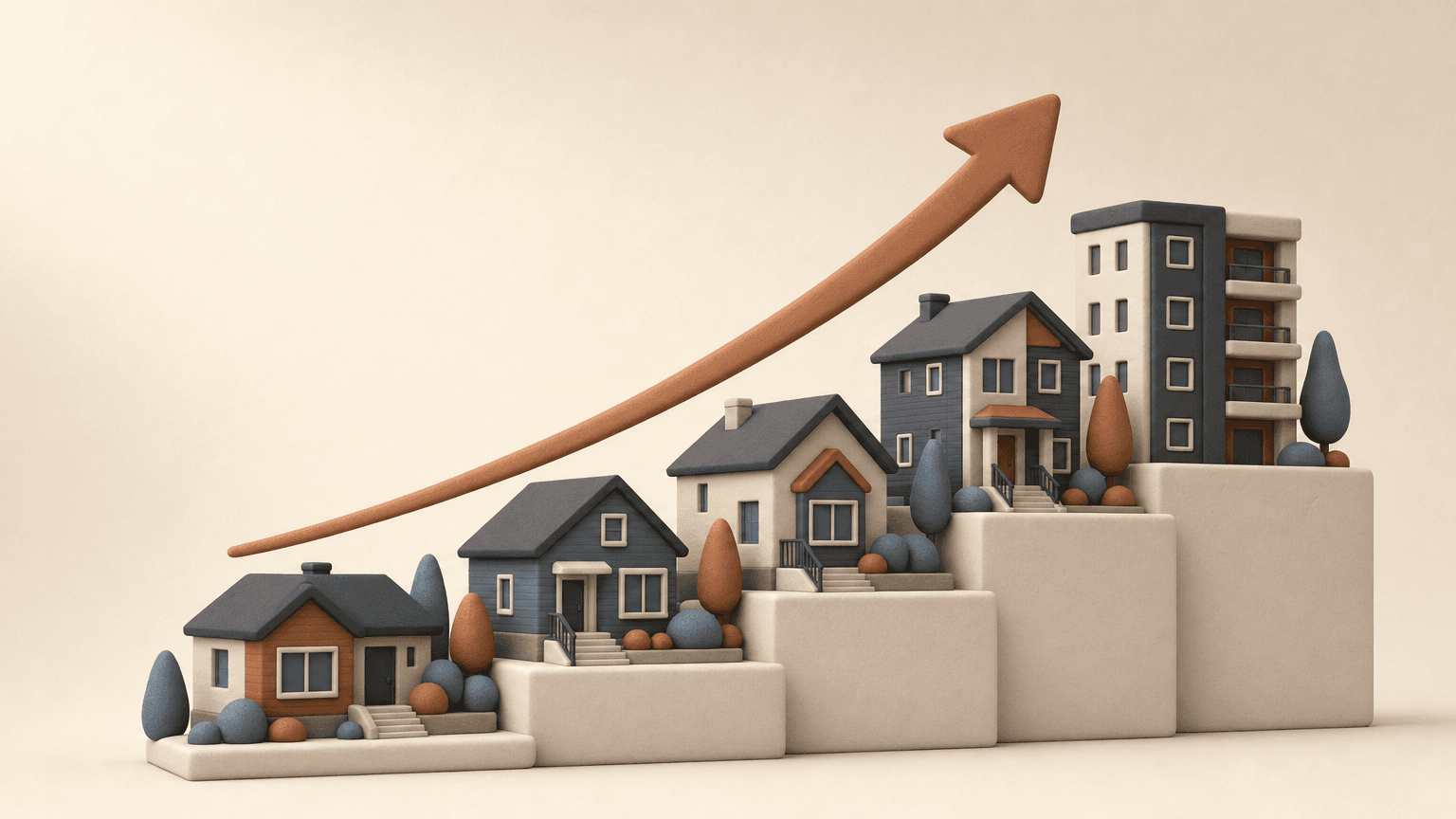
 Clay houses of varying sizes sized to show price differences between cities
What the live Edmonton market looks like right now
The historical median sold price for an Edmonton residential home is $472,584, with a median 29 days on hômm. That 29-day figure matters. It signals a liquid market where homes change hands at a healthy pace, not a stalled one where you would struggle to sell or rent.
Here is what is actually for sale in Edmonton today.


One caution on pricing. The active median list price for Edmonton homes is around $544,150, well above the $472,584 median that buyers have actually paid. That gap reflects what sellers are currently asking, and the mix of larger homes on the market right now. The sold median is the more honest number for what Edmonton buyers really pay. Treat the list price as a starting point for negotiation, not the going rate.
You can browse current Edmonton listings to see the full range, or read our guide on how buying works at hômm if you are new to the process. If a rental is your goal, our walkthrough on buying a rental property in Edmonton covers the step-by-step.
The condo angle for first-time investors
If $470,000 feels like a stretch, Edmonton condos open a lower door. The median Edmonton condo sold for $250,647, roughly 53% of the all-residential median price. That is one of the sharpest detached-to-condo price gaps among major Canadian cities.
Condos rent well here too. CMHC's 2025 Rental Market Report put the average 2-bedroom condo rent at $1,655 with a low 1.7% vacancy rate. Condo apartments now make up 37% of Edmonton's rental supply, after over 2,000 condo units were added to the long-term rental stock in 2025.
💡 Pro Tip: A lower entry price means a smaller down payment and a smaller mortgage, which often makes the cash-flow math work sooner. Use the cap rate calculator to compare a $250,000 condo against a $470,000 house side by side before you choose a lane.
A worked example using real Edmonton numbers
Numbers beat opinions, so let's build a simple case using the actual median condo price.
Say you buy a 2-bedroom Edmonton condo at the median sold price of $250,647. You put 20% down ($50,129) and finance the rest. At today's purpose-built and condo rents, a 2-bedroom commands somewhere around $1,603 to $1,655 a month, based on CMHC's 2025 figures.
Your gross annual rent at $1,655 a month is $19,860. Against a $250,647 purchase price, that is a gross yield near 7.9% before expenses. Your real return depends on condo fees, property tax, insurance, vacancy, and your mortgage rate, which is exactly why you should not eyeball it.
Plug your own figures into the cap rate calculator to get a net number you can trust, and run the financing side through the mortgage payment calculator to see your real monthly cost. For a deeper walk-through, our Edmonton cap rate guide for 2026 is the main resource in this series.
⚠️ Watch Out: Condo fees and special assessments can quietly erase your cash flow. Always pull the reserve fund study and recent meeting minutes before you buy. A healthy gross yield means nothing if a $20,000 assessment lands in year two.
Rents are rising, and tenants can afford them
A rising rent is good for an investor only if tenants can actually pay it. Edmonton has both.
Average 2-bedroom purpose-built rent hit $1,603 in October 2025, up 3.5% year-over-year. Occupied-unit rents rose 6.8% year-over-year in the first quarter of 2025. At the same time, Edmonton's rent-to-income ratio was just 12.5% in March 2025, the lowest among Canada's major metro areas.
That low ratio is the safety valve. Tenants here spend a smaller slice of income on rent than anywhere else among major cities, which leaves room for rents to keep rising without pricing renters out. Edmonton also had the smallest gap, just 5%, between asking rents on vacant units and rents on occupied units, so there is less of a sudden jump when a tenant turns over.
One note of balance. Vacancy rose to 3.8% in October 2025 as that wave of new construction came online. More choice for renters can slow rent growth, so the pace of rent increases may ease. The fundamentals still favour landlords, but go in with realistic rent assumptions, not last year's peak.
What could go wrong
No market is a sure thing, and Edmonton has real risks worth naming.
Alberta's economy still leans on energy. A sharp, sustained drop in oil prices can slow hiring and migration, which feeds straight into rental demand. New supply is the other watch item. If housing starts keep running at a high pace while population growth softens, vacancy could climb and rent growth could stall.
These are reasons to buy carefully, not reasons to stay out. Edmonton's affordability gives you a margin of safety that pricier cities simply do not offer. When you pay less for the asset, a soft year hurts less.
🎯 The Bottom Line: Edmonton checks the three boxes that matter for a real estate investor. Population is growing among the fastest of any major Canadian city, rents are rising while tenants stay able to afford them, and prices remain the most affordable among major metros. None of that guarantees a profit on a specific property, but it means the math can work here in a way it rarely does in Toronto or Vancouver. Do the homework on each deal, run the cap rate numbers honestly, and Edmonton is a serious place to invest.
Frequently Asked Questions
Is Edmonton a good place to invest in real estate in 2026?
Yes, the core fundamentals are strong. CMHC ranked Edmonton the most affordable major Canadian city in late 2025, the population grew 3.0% in the year ending July 2025 (among the fastest of any Canadian metro per Statistics Canada), and average 2-bedroom rent reached $1,603 in October 2025. Affordable prices plus growing demand create the conditions for positive cash flow that are hard to find elsewhere. Always run the numbers on each specific property before buying.
How much does an investment property cost in Edmonton?
The median Edmonton residential home sold for $472,584, while the median condo sold for $250,647. Condos give first-time investors a lower entry point at roughly 53% of the all-residential median price. With 20% down, a median condo needs about $50,129 upfront plus closing costs. Note that Alberta has no land transfer tax, which lowers closing costs compared to most provinces.
What is a good cap rate for an Edmonton rental property?
Cap rate depends on the property, but Edmonton's low prices relative to rent give it an edge over pricier markets. A median $250,647 condo renting near $1,655 a month produces a gross yield close to 7.9% before expenses. Your net cap rate after condo fees, taxes, insurance, and vacancy will be lower, so use the cap rate calculator to get a realistic figure for any property you consider.
Are rents rising in Edmonton?
Yes. CMHC reported average 2-bedroom purpose-built rent at $1,603 in October 2025, up 3.5% year-over-year, with occupied-unit rents up 6.8% in early 2025. Vacancy rose to 3.8% as new construction came online, which may slow the pace of increases. Edmonton's rent-to-income ratio of 12.5%, the lowest among major Canadian cities, suggests room for rents to keep climbing without pricing tenants out.
Why is Edmonton more affordable than Calgary, Toronto, or Vancouver?
Edmonton's 2024 average resale price was $424,510, compared to $622,457 in Calgary and $1,234,969 in Vancouver, according to CMHC. Toronto sits in the same seven-figure range as Vancouver. Edmonton has kept building homes to meet demand, with housing starts up 47% over the first nine months of 2024, which helps hold prices down even as population grows. That mix of steady supply and strong demand is the reason the affordability gap persists rather than closing.
Sources
- Statistics Canada
- Statistics Canada
- Statistics Canada
- Canada Mortgage and Housing Corporation (CMHC)
- Canada Mortgage and Housing Corporation (CMHC)
- Canada Mortgage and Housing Corporation (CMHC)
- Canada Mortgage and Housing Corporation (CMHC)
- Canada Mortgage and Housing Corporation (CMHC)
- Canada Mortgage and Housing Corporation (CMHC)
- Government of Alberta

John Rota is a REALTOR® and co-founder of one of Edmonton's top-producing real estate teams, established in 2017. Born and raised in Edmonton, he studied Construction Engineering Technology at NAIT and worked in residential construction before moving into real estate, bringing a builder's eye to construction quality, renovations, and what actually drives a home's value. John writes and reviews Edmonton market and mortgage coverage for homm.ca, grounded in live MLS® data.
What's your home worth?
Get a free home valuation based on recent sales in your area.
Get Your EstimateKeep reading
Financing a Rental Property in Canada: Down Payment and Rules
Rental properties in Canada require at least 20% down. Here are the federal financing rules, the stress test, and a worked Edmonton example using current MLS prices.
Secondary Suites and Garden Suites in Edmonton: Rules and ROI
A legal secondary suite can turn an Edmonton home into an income property. Here are the permits, building code rules, financing programs, and the real ROI numbers.
How to Find a Positive Cash Flow Rental in Edmonton
A positive cash flow rental pays you every month after every cost is covered. Here is how to find one in Edmonton, with real MLS prices, CMHC rent data, and a full worked example.
How to Buy a Rental Property in Edmonton (2026)
A 2026 guide to buying an investment property in Edmonton: how much you need down, the financing and stress-test rules, real MLS price anchors, Alberta landlord laws, and a worked cap rate example.