
Attached vs Detached Garage: Which Is Better in Alberta?
Attached garages win Alberta winters; detached garages win on lot flexibility and shop space. The real differences: code, zoning, heating, and where each layout lives in Edmonton.

On this pageShow
An attached garage shares a wall (and usually a door) with the house. A detached garage is its own building, in Edmonton almost always at the back of the lot off a rear lane. The two layouts split the city by era: attached garages dominate post-1980 suburbs, detached garages dominate mature neighbourhoods, and the choice touches everything from your January mornings to your permit file.
✅ Key Takeaways:
- At -30°C the difference is not subtle: an attached garage means never scraping ice inside your own coat. This is the single biggest reason Alberta buyers pay attention to the distinction.
- In Edmonton's RS zone, lots that back onto a lane must take vehicle access from the lane, and rear attached garages are not permitted there. On many mature-neighbourhood lots, detached is not a preference, it is the rule.
- July 2026 Edmonton data: listings mentioning a double attached garage carry a $550,000 median asking price; double detached, $479,000. The gap mostly reflects home age and location, not the garage itself.
The Layouts on a Lot
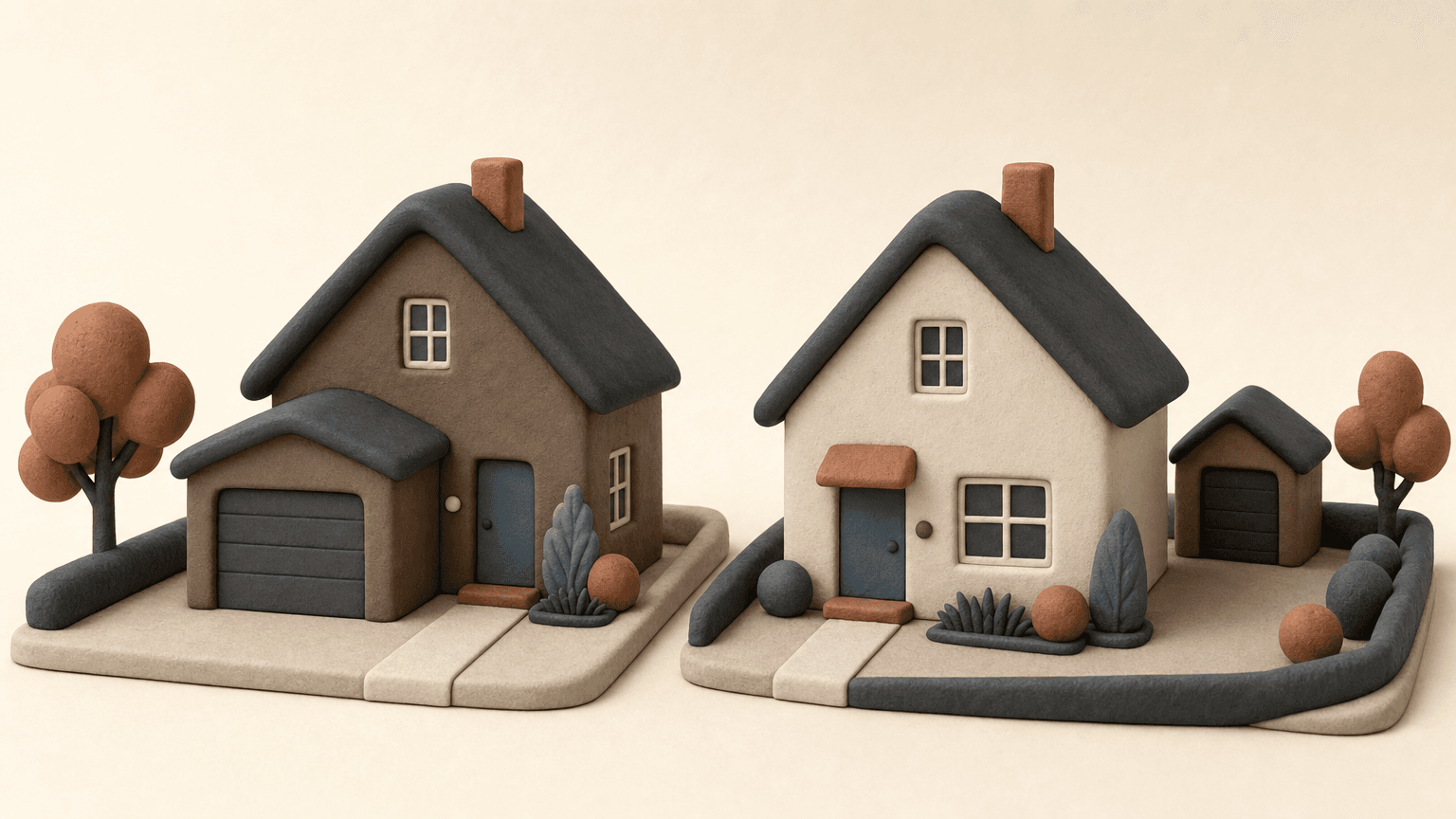
Attached vs Detached Garage
The site plan is the whole story. A front-attached garage puts the car inside your building envelope with direct access to the kitchen. A rear-detached garage frees the front of the house for windows and a porch, keeps driveway concrete off the front yard, and gives you a building you can treat as a shop. It also means carrying groceries across a February backyard.
Winter Is the Deciding Factor
Alberta is where this comparison stops being generic. With an attached garage the vehicle starts warmer, you load kids and groceries indoors, and there is no windshield to scrape. With a detached garage you keep the convenience of indoor parking but add a 15-second outdoor walk that feels much longer at -30.
A detached garage still beats a driveway by a wide margin. Any indoor stall keeps snow off the vehicle, and a plug for the block heater matters either way: Natural Resources Canada says a block heater can improve fuel economy by as much as 10 percent at -20°C, and recommends a timer that switches it on two hours before you drive so you are not paying to heat the engine all night.
 Snowy clay houses with warm glowing windows
Code and Safety: the Wall Between Car and Kitchen
An attached garage is the only garage type that shares air with your house, and Alberta's building rules treat that seriously. For a garage serving a single dwelling unit, the standard fire separation requirement is relaxed, but the garage must still be sealed from the house with an air barrier so exhaust fumes and carbon monoxide cannot migrate inside, and the connecting door has to meet code requirements. If you are buying a home with a secondary suite, ask whether the garage separation was handled properly; the exemption gets murkier when the garage serves more than one unit.
Detached garages skip that problem entirely, which is one reason they make better workshops: run equipment, store fuel, make noise, and the house neither hears nor smells it.
Zoning: Edmonton Often Chooses for You
On a mature-neighbourhood lot with a rear lane, Edmonton's RS zone requires vehicle access from the lane and does not permit rear attached garages, so the practical option is a detached garage out back. Accessory building rules apply: 4.3 m maximum height, 20 percent of the site at most, 0.6 m minimum from side and rear lot lines, and 1.2 m of setback where the garage door faces the lane. A new detached garage needs a development permit and building permit; fees start around $270 combined as of 2025.
Front-attached garages are a new-suburb pattern where lots are wide, there is no lane, and the driveway loads from the street.
💡 Pro Tip: Buying a mature-neighbourhood home with an old detached garage? Pull the Real Property Report before you fall in love. Garages built without permits or sitting over the property line are a classic Alberta closing-day problem, and the fix (a compliance review, an encroachment agreement, or rebuilding) lands on whoever the contract says it lands on. Our guide to garage types in Canada covers what belongs where.
Cost and Value
Building new, attached is usually cheaper per square foot because it shares a wall and foundation work with the house, while detached needs four walls and its own slab but costs nothing in house redesign, which is why almost all garage retrofits in mature Edmonton are detached. On resale, July 2026 Edmonton listings mentioning double attached garages show a median ask of $550,000 versus $479,000 for double detached, but that gap is mostly the age and location of the homes each layout comes with. Within the same neighbourhood and vintage, a good garage of either type beats no garage; check what comparable homes actually sold for before assuming a premium.
🎯 The Bottom Line: Pick attached for daily winter comfort and direct house access. Pick detached for shop space, a better-looking front elevation, and mature-neighbourhood lots where zoning has already made the decision. Neither is "better" in Alberta; they are different tools, and the lot usually tells you which one it wants.
Frequently Asked Questions
Is an attached or detached garage warmer? Attached garages borrow heat through the shared wall and typically sit well above outdoor temperature unheated. A detached garage tracks closer to outside unless you insulate and heat it deliberately; see what a heated garage involves.
Why do older Edmonton neighbourhoods have detached garages? Rear lanes. Mature areas were platted with alleys for services and parking, and current zoning keeps vehicle access on the lane for those lots, which means a detached garage at the rear. Front-attached garages arrived with laneless suburban lot design.
Can I attach an existing detached garage to my house? Rarely worth it. You would be rebuilding the connection to meet air-sealing and fire-separation rules, reworking the roofline, and repermitting. Most owners get more value insulating and heating the detached garage instead.
Does a detached garage need a permit in Edmonton? Yes: a development permit and building permit, plus electrical or gas permits for any services. Only an accessory building under 10 square metres with no utilities is permit-exempt, and no usable garage is that small.
Which adds more resale value? Neither layout carries a reliable, separable premium in Edmonton data. Capacity and condition matter more than attachment. A double garage of either type is a filterable must-have for many winter-weary buyers; search Edmonton homes by what matters to you.
Weighing a specific home? See what your current place is worth or talk to us about buying.
MLS figures are live Edmonton data as of July 2026. Zoning, setback, and permit rules are from City of Edmonton sources; building code notes summarize Alberta STANDATA guidance.
Sources

John Rota is a REALTOR® and co-founder of one of Edmonton's top-producing real estate teams, established in 2017. Born and raised in Edmonton, he studied Construction Engineering Technology at NAIT and worked in residential construction before moving into real estate, bringing a builder's eye to construction quality, renovations, and what actually drives a home's value. John writes and reviews Edmonton market and mortgage coverage for homm.ca, grounded in live MLS® data.
What's your home worth?
Get a free home valuation based on recent sales in your area.
Get Your EstimateKeep reading
What Is a Market Evaluation? (CMA, Explained)
Market evaluation, home evaluation, CMA, comparative market analysis: same report, different names. What is actually inside one, how sold comparables get adjusted, and when to get yours free.
How Homes Are Measured in Alberta: RMS and Square Footage
Alberta licensees must use the Residential Measurement Standard, which counts only above-grade finished space. Why a 1,200 sq ft bungalow with a finished basement is still a 1,200 sq ft home.
What Does Occupancy Mean in Real Estate? Occupancy vs Possession
Occupancy and possession date are not the same thing. The difference, why Alberta possession commonly lands around noon, and what changes when a listing shows a tenant.
Bungalow vs Semi-Bungalow: What They Mean in Alberta
Bungalow, semi-bungalow, 1.5 storey: what these terms actually mean on Alberta MLS® listings, and why bungalows often cost more per square foot in Edmonton.