
What Is a Detached House? Housing Types in Canada, Explained
"Detached" has a specific meaning in Canada: no shared walls and full lot ownership. How it compares to semi-detached, duplex, row house and apartment living, and why Edmonton's zoning is changing the mix.

On this pageShow
"Detached house" sounds simple until an MLS listing says "Duplex" or "Row House" and you're not sure where the line falls. The word decides how much land you own, whether a condo corporation has a say in your life, and how much privacy you get from your neighbours. Here's what "detached" means in Canada, and why Edmonton's zoning rules are quietly changing the mix on your street.
✅ Key Takeaways:
- A detached house shares no wall, floor or ceiling with another home; you own the lot outright with no condo corporation.
- Roughly half of Edmonton's housing stock is single-detached; semi-detached, duplex, row house and apartment homes fill out the rest.
- Edmonton's Zoning Bylaw 20001 now lets many single-detached lots hold semis, duplexes and row houses too, so a "detached neighbourhood" won't always stay that way.
What Is a Detached House?
The detached house meaning is simple: a single dwelling that stands completely on its own, sharing no wall, floor or ceiling with any other home. The only things it can touch are its own garage or shed.
Statistics Canada's 2021 Census tracks this as one of nine structural dwelling types. Single-detached houses made up 52.6% of Canada's occupied private dwellings, down from roughly 55% a decade earlier. In Edmonton, single-detached houses account for close to half of all occupied homes, with semi-detached, row houses and apartments splitting most of the rest.
On Edmonton's MLS, "Detached Single Family" is its own property type under the residential class, separate from Duplex, Row/Townhouse and Condo. That's the definition your REALTOR® uses to price a listing.
The Full Housing Spectrum, From Detached to Apartment
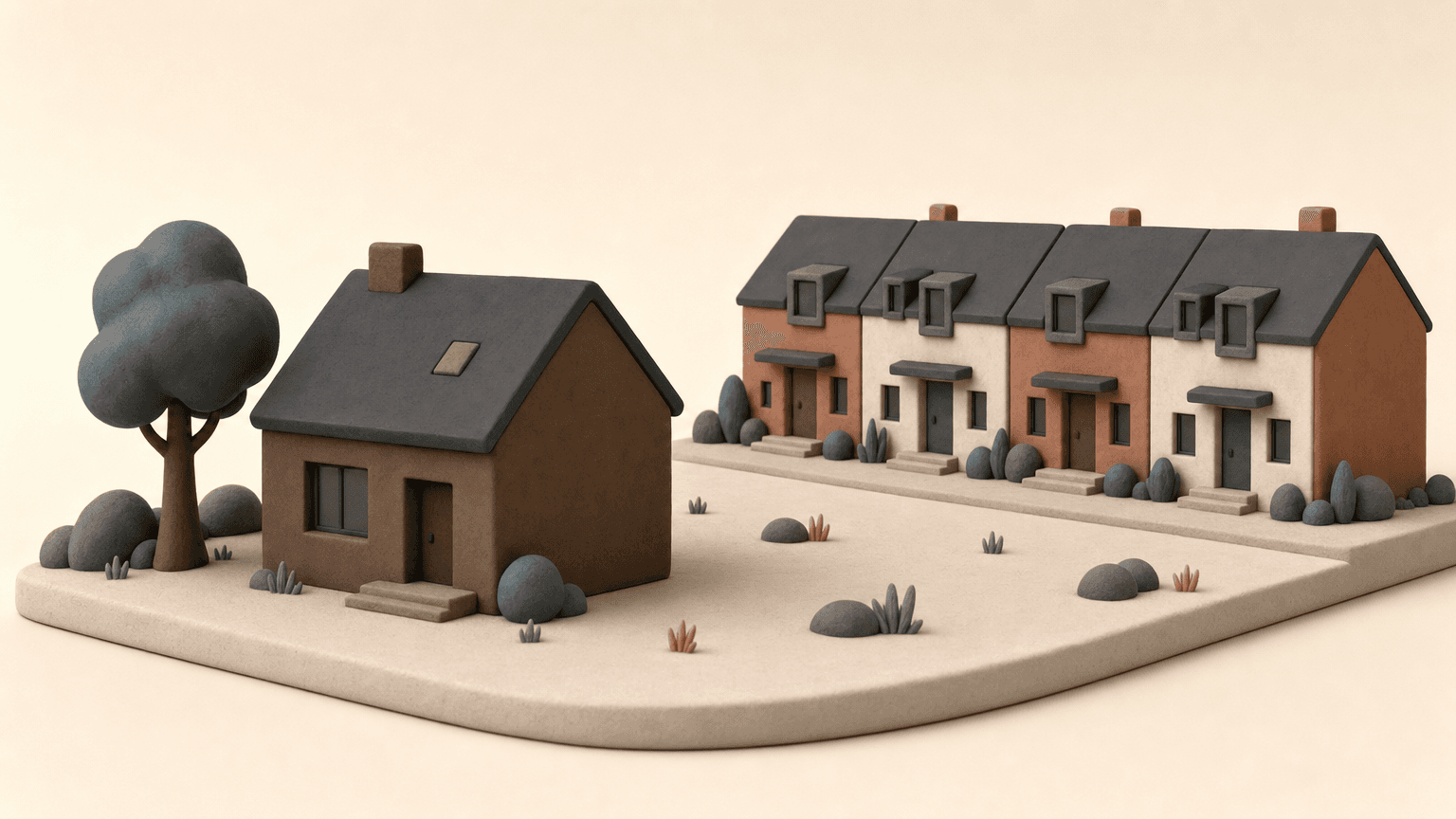
Canadian Housing Types: Detached to Apartment
Canada's housing stock runs along a spectrum. Each step trades some privacy and land for a lower price and less upkeep.
- Single-detached: Stands alone on its own lot, no shared walls.
- Semi-detached: Two homes joined side by side (or back to back) by one shared wall, each with its own entrance and title.
- Duplex: In Edmonton's Zoning Bylaw, one dwelling sits over another in the same building with separate access, unlike semi-detached, which sits side by side.
- Row house / townhouse: Three or more units joined in a line, sharing a wall on one or both sides.
- Apartment: Units stacked together, sharing walls, floors and ceilings, in a low-rise or high-rise building.
What "Detached" Actually Buys You
No shared walls means no shared noise or vibration, and no dispute over a party wall. You also own your lot outright, with no condo corporation, no reserve fund and no board voting on your renovation.
That freedom costs money. Detached houses carry the highest land cost per square foot in most Edmonton neighbourhoods, and you cover the whole roof, yard and driveway yourself. A semi-detached or row house splits some of that cost.
💡 Pro Tip: A garage doesn't decide whether a house is detached; that's about whether the house shares a wall, not whether its garage is attached or detached, or which garage type it has.
Semi-Detached vs Detached, and What Counts as "Attached"
A semi-detached house shares one wall with a single neighbour, each half on its own lot. It typically costs less than a comparable detached house, since you buy less land and share one wall. Most are still freehold in Edmonton, with their own title and no condo corporation.
"Attached house" is the broader term for any home sharing at least one wall with another dwelling: semi-detached houses, duplexes and row houses all qualify. It doesn't automatically mean condo. Many attached homes are freehold, while others are registered as condominiums, where a corporation owns common elements and collects fees. That ownership structure, not the wall itself, is what matters; see our condo vs strata explainer.
How Edmonton's Zoning Rules Changed the Mix
Edmonton's Zoning Bylaw 20001, in effect since January 1, 2024, lets its RS (Small Scale Residential) zone hold single-detached, semi-detached, duplex and row housing on lots that once allowed only one house.
"Missing middle" housing (row homes, duplexes, semis and small apartment buildings), per CMHC, grew from 26% of new starts across Canada's six largest cities in 2018 to 39% in 2024. Calgary and Edmonton alone produced 67% of that total, led by row homes.
⚠️ Watch Out: Love a detached house for its quiet block? Check the zoning on empty or aging lots nearby first. Under Edmonton's RS zone, many can now support a semi-detached, duplex or row development without a hearing.
Edmonton's Detached House Market Right Now
Detached houses remain the anchor of Edmonton's resale market, and they still trade at a premium over condos and townhomes.
Edmonton House Market Right Now
Edmonton's condo market currently carries a median list price around $245,634, well below a detached house. That gap buys land, privacy and freedom from a condo board. Browse current Edmonton listings to compare both.
🎯 The Bottom Line: "Detached" means no shared walls and full ownership of your lot, nothing more, nothing less. Whether that's worth the extra cost comes down to privacy and control versus a lower price and less upkeep.
Frequently Asked Questions
What is a detached house? A detached house stands completely on its own lot, with no shared walls, floors or ceilings with any other dwelling, aside from its own garage or shed.
What are detached homes worth compared to other housing types in Edmonton? Detached homes usually carry the highest price, because the price includes full lot ownership. Semi-detached, row houses and condo apartments cost less because you buy less land or share ownership through a condo corporation.
What is the difference between semi-detached and detached? A detached house has open space on all sides. A semi-detached house shares one common wall with a single neighbouring unit, though each side usually keeps its own title and entrance.
What is an attached house? An attached house shares at least one wall with another dwelling, including semi-detached houses, duplexes and row houses. It can be freehold, with its own title, or registered as a condominium with shared fees.
Is a duplex the same as a semi-detached house? No. In Edmonton's Zoning Bylaw, a duplex has one unit stacked over another inside a single building. A semi-detached house has two units side by side, sharing one common wall.
Browse current Edmonton houses for sale, compare recently sold homes across Edmonton, or get a free estimate if you already own one.
Sources: Statistics Canada, 2021 Census of Population (Structural Type of Dwelling); City of Edmonton, Zoning Bylaw 20001; Canada Mortgage and Housing Corporation (CMHC).

John Rota is a REALTOR® and co-founder of one of Edmonton's top-producing real estate teams, established in 2017. Born and raised in Edmonton, he studied Construction Engineering Technology at NAIT and worked in residential construction before moving into real estate, bringing a builder's eye to construction quality, renovations, and what actually drives a home's value. John writes and reviews Edmonton market and mortgage coverage for homm.ca, grounded in live MLS® data.
What's your home worth?
Get a free home valuation based on recent sales in your area.
Get Your EstimateKeep reading
What Is a Market Evaluation? (CMA, Explained)
Market evaluation, home evaluation, CMA, comparative market analysis: same report, different names. What is actually inside one, how sold comparables get adjusted, and when to get yours free.
How Homes Are Measured in Alberta: RMS and Square Footage
Alberta licensees must use the Residential Measurement Standard, which counts only above-grade finished space. Why a 1,200 sq ft bungalow with a finished basement is still a 1,200 sq ft home.
What Does Occupancy Mean in Real Estate? Occupancy vs Possession
Occupancy and possession date are not the same thing. The difference, why Alberta possession commonly lands around noon, and what changes when a listing shows a tenant.
Bungalow vs Semi-Bungalow: What They Mean in Alberta
Bungalow, semi-bungalow, 1.5 storey: what these terms actually mean on Alberta MLS® listings, and why bungalows often cost more per square foot in Edmonton.